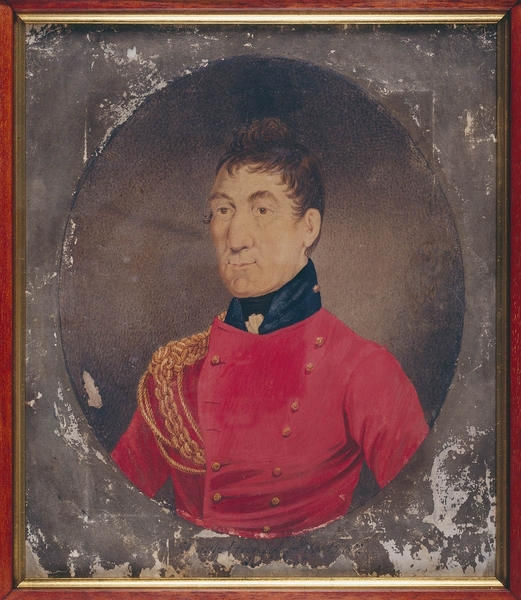
Showing posts with label Governor Lachlan Macquarie. Show all posts

Sunday, 3 April 2016

Historic St. Peter's Church of England, Richmond

Travelling down Windsor Street, in Richmond is the historic St Peter's Anglican Church, which has changed very little over the years.  The church with its adjoining rectory and coach house, and across the road, the burial ground and hall, sits in a small ridge, with a view to the mountains.

St Peter's Church of England, Richmond 1879
Courtesy State Library of NSW

In 1789 Governor Arthur Phillip explored the area around Richmond Hill. Five years later, settlers were granted land and given permission to reside in the Hawkesbury. The first services were conducted in Richmond in 1808 by Brother Youl but regular services were not customary until after the appointment of the resident chaplain, Reverend Robert Cartwright to the Church of England in the Hawkesbury in 1810. He served both Windsor and Richmond until 1814 when the parishes separated.  

Governor Lachlan Macquarie travelled to the Hawkesbury in 1810 and named the five towns of Richmond, Windsor, Wilberforce, Pitt Town and Castlereagh. In Richmond he selected the location “on a very beautiful elevated Bank and overlooking Pugh's Lagoon and adjoining rich lowlands." He visited again, about a month later, and recorded in his Journal in 1811: 
...the scite(sic) of the church, schoolhouse and burying ground were marked out by strong posts...The name of the town, painted on a board and nailed to strong lofty post was put close to the beautiful bank immediately above and overlooking Pugh's Lagoon and adjoining rich lowlands where it is intended to erect the Church at Richmond.[1]

The Richmond church lands were consecrated by Rev Samuel Marsden in 1811 and in that same year, the decision to construct a brick building was made at a meeting.  The community went about raising the funds, over two hundred pounds, to do so, however the schoolhouse-come-chapel, was not constructed until several years later. 

The two storeyed schoolhouse, similar to the one surviving at Wilberforce, was constructed next to the burial ground, measuring about 12 x 18 metres in size, and could seat up to one hundred people. It had accommodation on the ground floor with schoolroom upstairs which doubled as a chapel on Sundays. The first schoolmaster appointed to Richmond was Matthew Hughes and he taught at the school from 1813 until 1839. This was at a time when schooling was provided by the church, public education did not come about until much later in the nineteenth century.

As the town grew, it was evident a more substantial church building was required. A public meeting was held at the schoolhouse in 1835, headed by Rev Samuel Marsden. A Committee was formed, and a subscription list commenced where people could pledge donations. The church was designed by architect Francis Clarke (1801-1884) who was responsible for the design of several others churches including Mulgoa and Prospect. Tenders were advertised to construct the church in 1836 with local builder James Atkinson the successful builder. Construction of St. Peter's church was underway by late 1837 and took several years to build. It opened on 15 July 1841.

It was reported that: 
The new church, called St Peters was officially opened on Thursday and consecrated by [Bishop Broughton] the Lord Bishop of Australia, when all the responsible families in the town and neighbourhood were present. After the ceremony, a very large party of the gentry and clergy, with the Bishop, police magistrate, &c, were received at Hobartville, and entertained most hospitably by Mr. & Mrs. W. Cox. These meetings on such occasions do great good: they promote harmony, inspire confidence, and tend to unity; and it is a fair example of the really good feeling of the Australian community…[2]

The rectory, also designed by Clarke, was not completed until 1847. It is supposed to be similar to an English parsonage in Farnham Surrey, where Bishop William Grant Broughton lived for a period. A number of changes were made by the well-known architect Edmund Blacket to the rectory in 1863. The nearby coach house and stables have also survived.

The church was originally lit by candle and then kerosene lamp. Shortly after the end of the First World War, the electricity was connected. In 1849 a barrel organ was installed followed by an American styled organ in 1877. This was replaced in 1904 with a pipe organ. There have been a number of changes to the church including the addition of a side-porch, designed by Edmund Blacket, the construction of a chancel and gallery, and reorganisation of the pew layout occurring during the 1850s. Coloured glass windows were introduced in the 1870s, and in 1891 the gates and iron railing were erected. Several remarkable stained glass windows also adorn the church.

Church of England Schoolhouse circa 1870s
Courtesy State Library of NSW
The old schoolhouse was used until about 1874 and a new Sunday School Hall was built next to the cemetery facing Windsor Street. [3] The schoolhouse was demolished sometime later and a number of the bricks were used to build an obelisk outside the church, commemorating the early pioneers of the church and unveiled in 1933.

During the twentieth century the church experienced several disasters. In 1933 a heavy hailstorm smashed over thirty panes of glass from the windows. A wild storm demolished most of the spire in 1956 and it was necessary for it to be replaced. In 1964 the original ceiling was significantly water damaged.  

Burial entry for Margaret Catchpole who died in 1819 and is buried at St Peter's.
Photo: M. Nichols
The earliest recorded death in St Peters burial ground is that of five year old George Rouse who drowned in 1809. As this was before the cemetery was officially marked out and consecrated it is not known if he was actually buried or just commemorated on the headstone. 

View of rear of St Peters Cemetery
Photo: M. Nichols, 2016
There are a number of pioneers who came with the First Fleet in 1788 buried in the cemetery. Ex-convict Margaret Catchpole who arrived in 1801 and died in 1819 is also buried in the cemetery in an unmarked grave. William Cox junior and Andrew Town, both of Hobartville; Benjamin Richards who established the Riverstone Meatworks and botanist, Louisa Calvert nee Atkinson are some of the notable pioneers found in the cemetery.  
Hordern monument, St Peter's Cemetery
Photo: M. Nichols
The Hordern family monument (pictured above) with its exquisite angel is a feature of the cemetery. One bizarre fact is that the famous ornithologist John Gould, captured his first pair of Wonga Wonga pigeons in the cemetery in Richmond.


References
1. Lachlan Macquarie, Journals of his tours in NSW and Van Diemens Land 1810-1822. p.28
3. Macquarie Country by D. G. Bowd

Wednesday, 6 January 2016

Where Hawkesbury buried their dead ~ Trove Tuesday

Windsor Catholic Cemetery. Photo M. Nichols
Prior to 1810, inhabitants of the Hawkesbury buried their dead in various places including their properties, or along the riverbanks. There was also an early burial ground on the banks of South Creek at Green Hills (which was the original name of Windsor) but no records survive and the exact location is not confirmed, although a small plot of land has been set aside to commemorate early burials.

In 1811, the following Government Order, decreed by Governor Lachlan Macquarie was published in the Sydney Gazette stating that all burials were to take place in consecrated cemeteries. The Order stated:


The respective burial grounds which were sometime since marked out for the accommodation of the settlers in the several townships of Liverpool, Windsor, Richmond, Pitt Town, Castlereagh and Wilberforce having lately consecrated by the Principal Chaplain, His Excellency, the Governor is pleased to give this public notice, thereof and at the same time directs & commands that in future all settlers and other residents within those townships, or in their respective vicinities shall cease to bury their dead as heretofore within their several farms, & shall in a decent and becoming manner inter them in the consecrated grounds now assigned for that purpose in their respective Townships.


It was also recorded that when someone died, "notice of the event shall be immediately given to the Constable at the District wherein it has occurred, and the Constable receiving such information is hereby directed to communicate the same with the least possible delay to the nearest Resident Chaplain, in order that he may attend and perform the Funeral Service."

This order was not to be neglected and ignoring it could result in severe punishment. Further it became a "sacred duty ... to guard and protect the Remains of ... deceased Friends from every unnecessary Exposure."

Governor Lachlan Macquarie was keen the burial grounds be made available soon after and donated ten pounds towards the erection of a fence, to be built as quickly as possible. The first of these burial grounds to be established was at Windsor. Many people do not realise that the burial ground came first and was established adjacent to what was eventually to become St. Matthew's Church of England, which began construction in 1817.  Andrew Thompson who died in 1810 was in fact the first person buried in the burial ground. Henry Antill was responsible for selecting Thompson's burial site. 

Shortly after Windsor, burial grounds were established in Richmond, Wilberforce, Pitt Town, Castlereagh and Ebenezer. They were surveyed, marked out and then consecrated. 

Sunday, 6 December 2015

Macquarie's Towns

Over 200 years ago, Lachlan Macquarie, the Governor of NSW was touring the Hawkesbury district and named the 'Macquarie Towns.' After breakfast on Thursday 6 December 1810, Macquarie set out with a party which included surveyors as well as local residents, William Cox and Richard Fitzgerald. They travelled across the river to look for a suitable locality on the other side of the Hawkesbury River. His journal entry records this historic event at Windsor, formerly the Green Hills.  
Having crossed the Ferry at the Green Hills to the North side of the River, we proceeded … about 7 miles from the Green Hills; … where we looked for an eligible Spot for the intended Town and Township for the accommodation of the Settlers of the Phillip District [Wilberforce]and others inhabiting the Northern Bank of the River Hawkesbury, and after carefully surveying the different Parts of the Common we fixed on a very safe and convenient situation for the Town and Township in this part of the Country; which done we returned home and arrived at Government Cottage at 1/2 past 2 o'clock. Took some refreshment and walked out to survey the Grounds belonging to the Crown in and near the present village on the Green Hills [Windsor] and also the adjoining Public Common marked out for this part of the Country in the time of Governor King; a convenient part of which it is now my intention to appropriate for a large Town and Township for the accommodation of the Settlers inhabiting the South side of the River Hawkesbury, whose Farms are liable to be flooded on any inundation of the River, and to connect the present Village on the Green Hills with the intended new Town and Township. After viewing the ground and maturely considering the importance of the measure, the scite [sic] and situation of the new Town was at length fixed finally upon ---the exact scite of the new Church and Great Square being particularly marked out, as well as the extent and situation of the new Burying Ground; the Acting Surveyor, Mr. Meehan, receiving orders to measure and make out a Plan of the whole. 

Lachlan Macquarie, 1822 / Richard Read (ca. 1765-1827?)
From the collections of the State Library of NSW

A large Party of Friends dined with us today, consisting in all of 21 Persons … After Dinner I christened the new Townships, drinking a Bumper to the success of each. I gave the name of Windsor to the Town intended to be erected in the District of the Green Hills, in continuation of the present Village, from the similarity of this situation to that of the same name in England; the Township in the Richmond District I have named Richmond, from its beautiful situation, and as corresponding with that of its District; the Township for the Evan or Nepean District I have named Castlereagh in honor of Lord Viscount Castlereagh; the Township of the Nelson District I have named Pitt-Town in honor of the immortal memory of the late great William Pitt, the Minister who originally planned this Colony; and the Township for the Phillip District; on the North or left Bank of the Hawkesbury, I have named Wilberforce -- in honor of and out of respect to the good and virtuous Wm. Wilberforce Esqr. M.P. -- a true Patriot and the real Friend of Mankind.  

Map of Windsor
Source: Surveyor General Sketch books, State Records NSW 

Having sufficiently celebrated this auspicious Day of christening the five Towns and Townships, intended to be erected and established for the security and accommodation of the Settlers and others inhabiting the Cultivated Country, on the Banks of the Rivers Hawkesbury and Nepean; I recommended to the Gentlemen present to exert their influence with the Settlers in stimulating them to lose no time in removing their Habitations, Flocks & Herds to these places of safety and security, and thereby fulfil my intentions and plans in establishing them. 
 As soon as we had broke up from Table, Captain Antill, accompanied by Messrs. Lord and Moore, who had dined with us, set out by water for Scotland Island, a part of the Estate of the late Mr. Thompson, in order to take an account of his Property there, the rest of our Party returning to their respective Homes, highly gratified with their entertainment. 

Note: Journals of his Tour in NSW & Van Diemens Land by Lachlan Macquarie also available on Macquarie University’s Journeys in Time site


Thursday, 12 November 2015

Richmond Park

Located in the centre of Richmond, the ‘great square’ has played a central role in the community for over 200 years. Governor Lachlan Macquarie named Richmond in December 1810 (one of five ‘Macquarie Towns’) and the market place was laid out by the surveyor James Meehan in January 1811. It started out as 4 hectares and was bounded by West Market and East Market Streets however was reduced to 3.2 hectares when the land along West Market Street was assigned for government purposes including the watch house in the 1820s. In later years the Police Station, Court House, and the Post Office were established on the Windsor and West Market Street corner whilst the School of Arts and the Presbyterian School were further along closer to the March Street corner. Various trees and gardens have also been established over the years.
Richmond Park 1879, Government Printing Office Courtesy State Library of NSW Digital order no. d1_06267


The park has been used by the community for a variety of purposes over the years including recreation and sports. Large athletic days were held in the late 19th and 20th century. In the 1950s/60s/70s local schools met for combined school sports days. Both cricket and football have been played in the park for many years. The Pavilion (or Grandstand) was built by Samuel Boughton in 1884. The ‘RICHMOND’ sign (opposite the Royal Hotel end) was constructed in Boughton’s memory in 1922.

When the railway line operated between Richmond and Kurrajong the train cut across the edge of the park then travelled along March Street. Opposite the railway station the war memorials are situated, commemorating those who served in various conflicts. In latter years markets, picnics, carols by candlelight have been held in the park, which is managed by Hawkesbury City Council. The playground area has been modernised for new generations of children to enjoy. 

Following the end of World War 1 the community erected a monument opposite the Railway Station which is where by those who fought in the First World War and subsequent wars and conflicts are honoured. Names have been transcribed and can be viewed here.

Although there have been a number of renovations and changes in the park over the years it still remains an integral part of the town.


Wednesday, 31 July 2013

More than just a death - Trove Tuesday

Drownings were a regular occurrence in the Hawkesbury district specifically in the early 19th century. In 1826 Isabella Stoodley drowned near the mouth of Mangrove Creek when the boat she was travelling in accidentally upset near the mouth of Mangrove Creek. An inquest was held at Gunderman at Hibbs' farm situated on the Hawkesbury River. The Windsor Coroner, John Howe was in attendance and the verdict confirmed the cause of death was drowning. It was not the first time Isabella had been in the news. She appeared in the Sydney Gazette in April 1818 when her husband at the time, John Suddis, a settler at Wilberforce, was murdered.

The report of Isabella's death appeared in the Sydney Gazette in August 1826. The significance of this article is not only the report of an unfortunate drowning but also that it reveals some insight into the arrangements made regarding the burial of bodies, in localities away from a town centre as well as the difficulties in performing a funeral. It records that a piece of land had “been made sacred by the burial of one or more persons, but what has not been consecrated” and also mentioned that people preferred to bury “their relatives on their own farms” despite Governor Macquarie's edict 15 or so years earlier, that the deceased were to buried in consecrated burial grounds.

Sydney Gazette 5 August 1826, p. 2

The Windsor Correspondent for the newspaper enlightened readers with additional information about burials. This paragraph has some interesting concepts, and states:

     "The funeral service is generally read by the best reader present; although he may be considered     objectionable in other respects "Can he read?" This affirmed "Then he will do" Certainly a resident Chaplain would be a most invaluable treasure in such a district; the advantages society would derive from such an appointment, in affording instruction to the rising generation, may be in some degree conceived, but where would its influence terminate? It is worthy of remark, that the youths of that district are to form the Juries of this country. Where is their baptism; and where the record of their christenings? Much could be said on this interesting subject; but we submit it to consideration in the proper quarter. Where no doubt it will be speedily be noticed when known."

Location of the mouth of Mangrove Creek where Isabella drowned in 1826.
© Google Maps 2013
The value of using newspapers can never be underestimated. The benefits of using Trove to not only find information about people and events but the advantages of also adding unique background details to transform your research and make it thought provoking and stimulating.

Monday, 8 July 2013

Hawkesbury Settlers Address 1810

The following address was printed in the Sydney Gazette 8 Dec 1810, p. 1 from the settlers of Hawkesbury and presented to Governor Lachlan Macquarie in Windsor, by Thomas Arndell. Thomas, a prominent Hawkesbury resident, Magistrate was the Assistant Surgeon with the First Fleet in 1788. The address read:
    
"We, the undersigned settlers, residents of the Hawkesbury and its vicinity, beg leave respectfully to congratulate your Excellency on your arrival at this settlement, and earnestly hope your Excellency will be pleased with the agricultural improvements and industry that pervade here; and trust that the continuance of our exertions will ever merit your Excellency's approbation. We also beg leave to return our unfeigned thanks for your Excellency's recent appointment of William Cox, Esq., as a magistrate at this place - a gentleman who for many years has resided amongst us, possessing our esteem and confidence, who, from his local knowledge of this settlement, combined with his many other good qualities, will, we are convinced, promote your Excellency's benign intention of distributing justice and happiness to all." 

The settlers signing the address were as follows:

Thomas Appledore    William Etrel       John Merritt
Thomas Arkell           G.W. Evans        James Milaman
Thomas Arndell         William Ezzy        Patrick Murphy
Benjamin Baits          William Faithful    Henry Murray
William Baker           Daniel Fane         Richard Norris
Henry Baldwin          Robert Farlow     Charles Palmer
William Baxter          Edward Field       Thos. Matcham Pitt
John Baylis               R. Fitzgerald        James Portsmouth
David Bell                Thomas Gordon   Edward Pugh
John Benn                John Gregory       Paul Randall
Elias Bishop             Jonathan Griffiths  James Richards
James Blackman      Robert Guy           Jacob Russell
John Boulton           Thomas Hagger     John Ryan
John Bowman         George Hall           William Shaw
Paul Bushel             Thomas Hampson  William Simpson
William Carlisle       John Harris            William Small
Richard Carr          William Heydon      Robert Smith
Benjamin Carver     Thomas Hobby      Stephen Smith
Thomas Cheshire     John Jones            Benjamin South
Patrick Closhel        Donald Kennedy   Thomas Spencer
John Cobcroft         Henry Lamb          John Stevenson
Pierce Collett          Thomas Lambley   Owen Tierney
George Collis          John Leese            James Wall
Roger Connor         Matthew Lock       John Watts
Thomas Cowling     John Lyoner           James Welsh
Hugh Devlyn           Joseph McColding Thomas Weyham
John Dight              Daniel McKay        John Wild
William Dye           Thomas Markwell    Caleb Wilson
Elizabeth Earl         Robert Martin          Robert Wilson
William Eaton         Laurence May         Thomas Winston
Rowland Edwards   Martin Mentz          John Yoel
John Embrey        

Governor Macquarie responded:

"I beg you will make known to those respectable settlers of the Hawkesbury who signed the address presented by you to me, that I am much pleased with the sentiments it conveys, and to assure them that it will always be an object of the greatest interest to me to promote their prosperity by every means in my power. With this view I have fixed on ground for four(sic) different townships for the accommodation of the settlers who have suffered so severely by the floods of the river; and by a speedy removal to those situations of security, I hope they will enjoy the fruits of that labour, which, I am happy to observe, promises this season to be rewarded with one of the finest crops I ever beheld in any country. I hope on my return to this part of the colony to find the new habitations built on an improved and enlarged plan to those hitherto erected on the banks of the Hawkesbury. I am very glad to find that my appointment of Mr. Cox has met with the satisfaction of the settlers, and I have every reason to believe that he will fulfil the duties of his office so as to gain the good will of all."

Hawkesbury River at Windsor NSW.  M. Nichols 2013

Tuesday, 11 June 2013

Trove Tuesday - Death of Andrew Thompson 1773-1810

Andrew Thompson, despite arriving in the colony as a convict on the Pitt in 1792, went on to become one of the Hawkesbury's most celebrated pioneers. Thompson was renowned for his work as a Chief Constable, and magistrate but was also a farmer, brewer and businessman, accumulating a huge estate.  His premature death in 1810 was mourned by Governor Lachlan Macquarie, the elite of the colony as well as the local Hawkesbury community. His obituary in the Sydney Gazette reads


At Hawkesbury, Green Hills, on Monday the 22d Instant, after a lingering and severe illness, aged 37, Andrew Thompson, Esq. Magistrate of that District. In retracing the last twenty years of the life of this exemplary and much lamented Character will not be held uncharitable to glance at the lapse from rectitude which in an early and inexperienced period of youth destined him to these shores, since it will stamp a more honourable Tribute to his Memory to have it recorded, that from his first arrival in this Country he uniformly conducted himself with that strict regard to morality and integrity, as to obtain and enjoy the countenance and protection of several succeeding Governors; active, intelligent and industrious, of manners mild and conciliatory, with a heart generous and humane, Mr. Thompson was enabled to accumulate considerable property; and what was more valuable to him, to possess the confidence and esteem of some of the most distinguished Characters in this Country; the consciousness of which surmounted the private solicitude of revisiting his native Country, and led him rather to yield to the wish of passing the evening of his life where his manhood had been meritoriously exerted, than of returning to the land which gave him birth. Mr Thompson's intrinsic good qualities were appreciated by His Excellency the present Governor, who soon after his arrival here was pleased to appoint him a Magistrate, for which situation Mr. Thompson's natural good sense and a superior knowledge of the Laws of his Country peculiarly qualified him. 
Nor can we close this Tribute to his Memory without recurring to the important services Mr. Thompson rendered this Colony, and many of his fellow-creatures, during the heavy and public distresses which the floods at the Hawkesbury produced amongst the Settlers in that extensive District; Mr. Thompson's exertions were on a late occasion for two days and two nights unremittingly directed to the assistance of the sufferers, and we hasten to add, that in these offices of humanity, he not only exposed himself to personal danger, but laid the foundation for that illness which has deprived the World of a valuable life.
During the unfortunate Disturbances which lately disrupted this Colony, he, whose death we now lament, held on the even "Tenor of his Way," and acquitted himself with mildness, moderation and wisdom, and when the ruthless Hand of Death arrested his earthly career, he yield with becoming fortitude, and left this World for a better, with humble and devout resignation, and an exemplary confidence in the Mercies of his God.
Source: Family Notices. (1810, October 27). The Sydney Gazette and New South Wales Advertiser (NSW : 1803 - 1842), p. 3. Retrieved June 11, 2013, from http://nla.gov.au/nla.news-article628118

The square, located on a ridge between the Hawkesbury River and South Creek, was named Thompson Square by Macquarie in honour of his friend. He also erected a lengthy monument on his grave in St. Matthew's Church of England Cemetery in 1813 with "respect and esteem for the Memory of the deceased."