Showing posts with label Green Hills. Show all posts

Wednesday, 6 January 2016

Where Hawkesbury buried their dead ~ Trove Tuesday

Windsor Catholic Cemetery. Photo M. Nichols
Prior to 1810, inhabitants of the Hawkesbury buried their dead in various places including their properties, or along the riverbanks. There was also an early burial ground on the banks of South Creek at Green Hills (which was the original name of Windsor) but no records survive and the exact location is not confirmed, although a small plot of land has been set aside to commemorate early burials.

In 1811, the following Government Order, decreed by Governor Lachlan Macquarie was published in the Sydney Gazette stating that all burials were to take place in consecrated cemeteries. The Order stated:


The respective burial grounds which were sometime since marked out for the accommodation of the settlers in the several townships of Liverpool, Windsor, Richmond, Pitt Town, Castlereagh and Wilberforce having lately consecrated by the Principal Chaplain, His Excellency, the Governor is pleased to give this public notice, thereof and at the same time directs & commands that in future all settlers and other residents within those townships, or in their respective vicinities shall cease to bury their dead as heretofore within their several farms, & shall in a decent and becoming manner inter them in the consecrated grounds now assigned for that purpose in their respective Townships.


It was also recorded that when someone died, "notice of the event shall be immediately given to the Constable at the District wherein it has occurred, and the Constable receiving such information is hereby directed to communicate the same with the least possible delay to the nearest Resident Chaplain, in order that he may attend and perform the Funeral Service."

This order was not to be neglected and ignoring it could result in severe punishment. Further it became a "sacred duty ... to guard and protect the Remains of ... deceased Friends from every unnecessary Exposure."

Governor Lachlan Macquarie was keen the burial grounds be made available soon after and donated ten pounds towards the erection of a fence, to be built as quickly as possible. The first of these burial grounds to be established was at Windsor. Many people do not realise that the burial ground came first and was established adjacent to what was eventually to become St. Matthew's Church of England, which began construction in 1817.  Andrew Thompson who died in 1810 was in fact the first person buried in the burial ground. Henry Antill was responsible for selecting Thompson's burial site. 

Shortly after Windsor, burial grounds were established in Richmond, Wilberforce, Pitt Town, Castlereagh and Ebenezer. They were surveyed, marked out and then consecrated. 

Sunday, 6 December 2015

Macquarie's Towns

Over 200 years ago, Lachlan Macquarie, the Governor of NSW was touring the Hawkesbury district and named the 'Macquarie Towns.' After breakfast on Thursday 6 December 1810, Macquarie set out with a party which included surveyors as well as local residents, William Cox and Richard Fitzgerald. They travelled across the river to look for a suitable locality on the other side of the Hawkesbury River. His journal entry records this historic event at Windsor, formerly the Green Hills.  
Having crossed the Ferry at the Green Hills to the North side of the River, we proceeded … about 7 miles from the Green Hills; … where we looked for an eligible Spot for the intended Town and Township for the accommodation of the Settlers of the Phillip District [Wilberforce]and others inhabiting the Northern Bank of the River Hawkesbury, and after carefully surveying the different Parts of the Common we fixed on a very safe and convenient situation for the Town and Township in this part of the Country; which done we returned home and arrived at Government Cottage at 1/2 past 2 o'clock. Took some refreshment and walked out to survey the Grounds belonging to the Crown in and near the present village on the Green Hills [Windsor] and also the adjoining Public Common marked out for this part of the Country in the time of Governor King; a convenient part of which it is now my intention to appropriate for a large Town and Township for the accommodation of the Settlers inhabiting the South side of the River Hawkesbury, whose Farms are liable to be flooded on any inundation of the River, and to connect the present Village on the Green Hills with the intended new Town and Township. After viewing the ground and maturely considering the importance of the measure, the scite [sic] and situation of the new Town was at length fixed finally upon ---the exact scite of the new Church and Great Square being particularly marked out, as well as the extent and situation of the new Burying Ground; the Acting Surveyor, Mr. Meehan, receiving orders to measure and make out a Plan of the whole. 

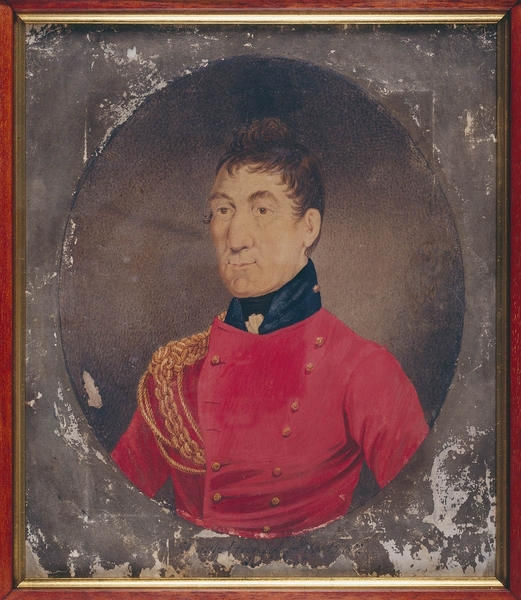
Lachlan Macquarie, 1822 / Richard Read (ca. 1765-1827?)
From the collections of the State Library of NSW

A large Party of Friends dined with us today, consisting in all of 21 Persons … After Dinner I christened the new Townships, drinking a Bumper to the success of each. I gave the name of Windsor to the Town intended to be erected in the District of the Green Hills, in continuation of the present Village, from the similarity of this situation to that of the same name in England; the Township in the Richmond District I have named Richmond, from its beautiful situation, and as corresponding with that of its District; the Township for the Evan or Nepean District I have named Castlereagh in honor of Lord Viscount Castlereagh; the Township of the Nelson District I have named Pitt-Town in honor of the immortal memory of the late great William Pitt, the Minister who originally planned this Colony; and the Township for the Phillip District; on the North or left Bank of the Hawkesbury, I have named Wilberforce -- in honor of and out of respect to the good and virtuous Wm. Wilberforce Esqr. M.P. -- a true Patriot and the real Friend of Mankind.  

Map of Windsor
Source: Surveyor General Sketch books, State Records NSW 

Having sufficiently celebrated this auspicious Day of christening the five Towns and Townships, intended to be erected and established for the security and accommodation of the Settlers and others inhabiting the Cultivated Country, on the Banks of the Rivers Hawkesbury and Nepean; I recommended to the Gentlemen present to exert their influence with the Settlers in stimulating them to lose no time in removing their Habitations, Flocks & Herds to these places of safety and security, and thereby fulfil my intentions and plans in establishing them. 
 As soon as we had broke up from Table, Captain Antill, accompanied by Messrs. Lord and Moore, who had dined with us, set out by water for Scotland Island, a part of the Estate of the late Mr. Thompson, in order to take an account of his Property there, the rest of our Party returning to their respective Homes, highly gratified with their entertainment. 

Note: Journals of his Tour in NSW & Van Diemens Land by Lachlan Macquarie also available on Macquarie University’s Journeys in Time site


Saturday, 28 June 2014

Toll House at Windsor

If you have ever travelled to Windsor along Windsor Road and over the Fitzroy Bridge at South Creek, you may have noticed the small white building tucked next to the bridge. This is the Toll House, where during the nineteenth century, tolls were collected for using the road. If your ancestors lived in the Hawkesbury during the 1800s they would have most likely paid tolls here at some time or other. It is one of only two intact toll houses remaining in NSW, the other is at Mt Victoria in the Blue Mountains.

The concept of charging tolls for the use of a road or ferry was in wide use throughout the United Kingdom and Europe and was introduced into NSW by Governor King in 1802. Permission was granted to Andrew Thompson  to charge a toll for the use of his "floating bridge" over South Creek near the Green Hills (now Windsor) in 1802. There was possibly earlier buildings on the present site however there are no surviving records. 

Sydney Gazette & NSWAdvertiser 9 March 1806, p. 1
Retrieved  from http://nla.gov.au/nla.news-article627036
 

Tenders were called for a Toll House in 1834 and the building was completed in 1835. In the 1864 flood "the town the waters came up within a foot of the Barrack gate, Bridge-street ; and the Fitzroy Bridge was totally under water. The toll-house and adjoining houses...were entirely flooded" according to the Sydney Morning Herald newspaper. As a result the building was practically demolished as a result of the 1864 flood when the building was actually shifted off its foundations. It was rebuilt with some alterations shortly after. It is a small building with three rooms and a projected bay window, which the toll keeper could view the road from both angles, to collect tolls. 

In 1886 a deputation was made to the Minister for Works, urging the toll to be abolished as it was unjust particularly as many others throughout the country had been removed. The toll was eventually abolished by the Windsor Road Trust in 1887.

Toll House at Windsor  1947 Courtesy of the State Library of NSW [No. d1_40918]

In 1975 a new high level bridge was constructed over South Creek almost concealing the Toll House from view. The building, has in the past, been damaged by both vandals and rising flood-waters however the exterior of the building was restored in 1997. The public can view the Toll House from the outside by walking from Court Street, on the pathway down beside the Fitzroy Bridge.


Sources :
Exploring the Hawkesbury / Ian Jack
Macquarie Country / D. G. Bowd
Windsor Toll House : user pays in the 19th century / Justin O'Connell
Sydney Gazette & Sydney Morning Herald newspapers on Trove http://trove.nla.gov.au/newspaper