Thursday, 12 November 2015

Richmond Park

Located in the centre of Richmond, the ‘great square’ has played a central role in the community for over 200 years. Governor Lachlan Macquarie named Richmond in December 1810 (one of five ‘Macquarie Towns’) and the market place was laid out by the surveyor James Meehan in January 1811. It started out as 4 hectares and was bounded by West Market and East Market Streets however was reduced to 3.2 hectares when the land along West Market Street was assigned for government purposes including the watch house in the 1820s. In later years the Police Station, Court House, and the Post Office were established on the Windsor and West Market Street corner whilst the School of Arts and the Presbyterian School were further along closer to the March Street corner. Various trees and gardens have also been established over the years.
Richmond Park 1879, Government Printing Office Courtesy State Library of NSW Digital order no. d1_06267


The park has been used by the community for a variety of purposes over the years including recreation and sports. Large athletic days were held in the late 19th and 20th century. In the 1950s/60s/70s local schools met for combined school sports days. Both cricket and football have been played in the park for many years. The Pavilion (or Grandstand) was built by Samuel Boughton in 1884. The ‘RICHMOND’ sign (opposite the Royal Hotel end) was constructed in Boughton’s memory in 1922.

When the railway line operated between Richmond and Kurrajong the train cut across the edge of the park then travelled along March Street. Opposite the railway station the war memorials are situated, commemorating those who served in various conflicts. In latter years markets, picnics, carols by candlelight have been held in the park, which is managed by Hawkesbury City Council. The playground area has been modernised for new generations of children to enjoy. 

Following the end of World War 1 the community erected a monument opposite the Railway Station which is where by those who fought in the First World War and subsequent wars and conflicts are honoured. Names have been transcribed and can be viewed here.

Although there have been a number of renovations and changes in the park over the years it still remains an integral part of the town.


Wednesday, 4 November 2015

Melbourne Cup winner - Trove Tuesday

Grand Flaneur was an extraordinary thoroughbred racehorse who won numerous races including the Melbourne Cup in 1880. He retired with an outstanding career, undefeated earning over £8000.

GRAND FLANEUR - Courtesy Tyrell Collection, Powerhouse Museum 

After his retirement he spent many years at Hobartville stud at Richmond, once the property of Andrew Town which came into the hands of W. A. Long after Town's bankruptcy. Long was Grand Flaneur's owner. The great stallion sired a number of foals after being put out to pasture and no longer racing. He died at William Long's stud at Chipping Norton in April 1900. He was mourned by many and obituaries appeared in many newspapers including the Town & Country Journal 28 April 1900. This paper also produced a family tree of the horse.

A street bears the name of the famous sire in Hobartville.

Clarence River Advocate 24 April 1900

Tuesday, 27 October 2015

Family Millions - Trove Tuesday

Over the years there have been many articles published about money languishing in chancery, waiting for families to make a claim. In 1913 from the following paragraph from the Windsor & Richmond Gazette mentioned money in chancery and how it affected some Hawkesbury families:
We are told that several millions of money now in Chancery are shortly to be claimed, and that a number, of Hawkesbury families will be beneficiaries. The families interested are the Hobbses, Of Forrester; Mrs. Sullivan, senr., of Wilberforce; the family of the late Joshua Jones, the Bootles, of Pitt Town, and others. A representative, goes to England early next year to claim the enormous fortune.
During the 1920s hundreds of articles appeared in newspapers all over Australia. The following example compiled by George Reeve, a local historian who often wrote historical based articles, shows how useful these types of articles can be, providing names , places and dates. Check out The story of Robert Hobbs 
The story of Robert Hobbs (1926, May 28). Windsor & Richmond Gazette p. 6

There was even correspondence from New Zealand. In 1928 several letters were published from Mr G. A. Hobbs from Foxton, New Zealand in the Windsor & Richmond Gazette. In 1931 it was recorded that there were at least "360 claimants to the Hobbs millions" and there were "several unsuccessful attempts to secure the fortune."  In the UK newspapers reported similar instances, including Lancashire Evening Post - Thursday 30 July 1931. There was information about the Rose Millions published in 1925.

In the Yorkshire Post & Leeds Intelligencer 25 August 1930, Australian descendants of the Hobbs and Rose families pooled £3,000 to send representatives to England to claim the fortune. The Rose Millions was apparently worth £25,000,000 and the Hobbs £8,000,000. The applicants claimed the “Roses’s mother was a Lady-in-waiting to Queen Charlotte, and that John Rose was a natural son of George III. They allege that George III, left extensive property in various English counties in trust for John Rose.” It was “claimed on behalf of the Hobbs claimants that John Rose married Harriet Hobbs.”

In 1925 George Reeve wrote about the Ebenezer pioneers and the Everingham fortune. Again during the next few decades, hundreds of articles were published in various Australian newspapers, including the following:
Everingham Millions (1929, October 4). Windsor & Richmond Gazette, p. 11

As well as the Hobbs, Everinghams, there was also  the Clarks Millions in 1927 and the Brewers Mystery Millions the same year. In 1929 there was talk of changing the Everingham Millions to the Chaseling Millions. There was also the Green Millions and of particular interest to my own family, the Jennings Millions in 1929.

The publishing of information about these supposed fortunes often provide fascinating information for family historians. Over the years, these stories have gripped generations and despite some of the untruths, they are an amazing read.

Saturday, 22 August 2015

Windsor's McQuade Bridge

There are several things in Windsor named after the McQuade family including McQuade Park and McQuade Avenue but did you realise there were plans to call the bridge across the Hawkesbury River  at Windsor, McQuade Bridge?

In 1871 local government was established in the Hawkesbury when the Windsor Borough Council began. The newly established council named the reserve, Windsor Park, however this was rescinded in 1874 by John McQuade, the Mayor.

John Michael McQuade was born about 1826 and was the son of convict Michael McQuade and his wife, Sarah Conolly. McQuade was elected as one of the first councillors and served two terms as Mayor, first in 1872 and then in 1874. After he rescinded the decision to to name the reserve, Windsor Park, he then used his casting vote to rename it McQuade Park. 

A sign “was erected with McQuade Park painted in gold letters.” It was vandalised on more than once and “was smeared with tar and had to be repainted.” On 6 March 1878, When William Walker was serving as Mayor, all of the previous resolutions relating to the naming of the park were rescinded and the name Windsor Park was given. This however was futile was as the name was in the common use and it has remained unofficially McQuade Park.

In June 1874 a letter to the editor of the Australian, Windsor, Richmond & Hawkesbury Advertiser newspaper, published in Windsor, was printed. The writer was anonymous, using the non-de-plume 'Sagittarius' informed readers that friends of Mr. McQuade were trying to have the new bridge in Windsor called the McQuade Bridge. It goes on to state:
To be forewarned is to be forearmed. Surely it is sufficient, and more than sufficient, to have the park called after that individual, but pray do not tamely submit to having the new bridge burlesqued in this way. Whatever has McQuade done for the district to entitle his name to be appended to your public buildings in any way? Whatever has he or his ancestry or descendants ever done to deserve any distinction—any public recognition whatever? Have they added to the moral stamina of the district? Have they added to its respectability? Have they increased its intelligence? What have they done? If so name the bridge 'McQuade' it is a pretty name! These are most important questions, and to my mind not to be trifled with. I therefore trust that some influence will be used, to prevent the name of the new bridge from being prostituted by any other name than that of the ' Windsor' or ' Hawkesbury' bridge. I do think I would be a grave mistake to name the bridge after McQuade. The bridge crossing the Macquarie at Bathurst, is named after the Governor of the day, ' Denison.'
Other bridges are named after the townships in which they are built, and I know of none in the colony where they are named after a comparatively obscure individual. Call it 'Robinson Gap' or the 'Devils Causeway' ; but do not, pray do not give a name that will puzzle future generations, and perhaps in their minds give rise to Tipperary ideas or Donnybrook notions.
Should the bridge be called McQuade what will those say who come after us? Who was McQuade? Where did he come from?  Where has he gone to? Are his sons living? If not what were they when in the flesh? All these ideas will burst upon the innocent minds of future generations, and it will be well if a Gosper, a Primrose or a Moses should be alive to answer them. Much better if a Dean should then exist, to whip their recreant imaginations beyond the McQuade folly.
The plan never came to fruition and the structure was named, and remains, the Windsor Bridge. It was officially opened on the 20 August 1874 and still stands proudly crossing the majestic Hawkesbury River.

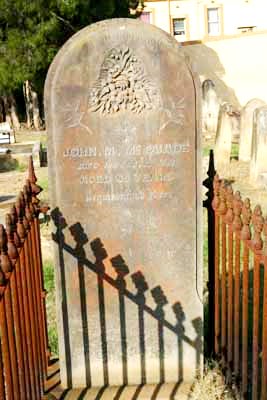
McQuade died 19 August 1891 aged 65 and is buried in the Windsor Catholic Cemetery.

 McQuade's headstone in Windsor Catholic Cemetery.
Photo: Michelle Nichols


Friday, 20 February 2015

Fruit growing in the Hawkesbury

Fruit has been grown in the Hawkesbury since the early 1800s and by 1810 there were over 100 hectares of orchards growing peaches, plums and apricots.  From the 1820s the cooler climate in the Kurrajong area became popular to grow fruit and the hills were covered with fruit bearing trees.

Stone fruits and apples were well-suited to the elevated areas of Kurrajong and Bilpin were suitable for stone fruits and apples. Granny Smith, Delicious and Jonathan apples were grown. Some orchards grew peas in between the trees as an additional crop.

Orchards at Kurrajong early 1900s
Courtesy State Records NSW Digital ID: 12932_a012_a012X2450000131


Did you know by 1890 the Hawkesbury grew over 195,000,00 oranges? In the 1930s the district was struck with an outbreak of fruit fly forcing a number of orchards to shut down. Other fruit grown included pears, plums, currants, gooseberries, strawberries and cherries all performed well. Melons were grown up and down the river and were easily transported by riverboat. By 1944 there were still 286,000 citrus bearing trees all over the Hawkesbury which was 20% of NSW total. The 1956 flood destroyed a lot of the orchards situated along the riverbanks. Beautiful peaches also were grown around Wisemans Ferry and Maroota – who can ever forget the taste? 

Unfortunately the number of orchards in the Hawkesbury has drastically reduced over the past 30 years with only a handful remaining.

Friday, 16 January 2015

The Hawkesbury River - the Rhine of Australia

One of Britain's most popular nineteenth century authors, Anthony Trollope 1815-1882, wrote in 1873, the following, comparing the Hawkesbury River to other grander rivers found elsewhere around the landscape.


The Hawkesbury River has neither castles or islands, nor has it bright clear water like the Rhine 
but the headlands are higher, the bluffs are bolder, and the turns and manoeuvres of the 
course which the waters have made themselves, are grander, and to me more enchanting 
than those of either the European or American River.

Riverscape scene near Wisemans Ferry on the Hawkesbury River NSW, 1880-1909. One of a series of photographs probably taken on the Hawkesbury River by William Frederick Hall between 1880 and 1909.
From the collection of the Australian National Maritime Museum, viewed on Flickr 

Trollope was visiting his son Frederick who was living at the time in Grenfell NSW, he then travelled extensively around the countryside. He went by boat from Sackville past Wisemans Ferry and onto Sydney, accompanied by a number of politicians including the then Premier of NSW, Sir James Martin. Trollope was very impressed by the Hawkesbury as a destination and compared it favourably to the Rhine in Europe. He took copious notes and he published several books following the trip including his travels in a publication titled 'Australia and New Zealand' in 1873.

Title page of Australia and New Zealand published in 2 volumes


Trollope Reach, located just past Wisemans Ferry on the Hawkesbury River, was named in his memory. Trollope passed away 6 December 1882 in London and is buried at Kensal Green. He wrote over 50 publications, most of which can be viewed for free online at eBooks@Adelaide

Friday, 2 January 2015

Government Labour Settlement at Pitt Town

On the outskirts of Pitt Town is Nelson Common, it was established by Governor King in 1804 for settlers to use for grazing stock. One of several commons in the Hawkesbury district, it covered an area of over 2,000 hectares and later became known as the Pitt Town Common. 

In the early 1890s, part of Pitt Town Common was set aside as a Government Labour Settlement or Camp. Set up on 930 hectares, the settlement enabled the breadwinners of selected families during the 1890s depression, an alternative lifestyle operating along the lines of a co-operative or commune. By 1894 over 500 residents were living onsite; however it was disbanded after only a few years. 


Windsor & Richmond Gazette 30 September 1893 p. 5 

In 1894 the local newspaper reported that, "Close upon 600 men, women, and children are now located on the Pitt Town Labour Settlement, the men all industrious and hard-working beings, compelled through stress of bad times and absolute lack of employment to seek to make homes for themselves under new and altered conditions." The powers to be did not have the means to provide the inhabitants with clothing, in light of winter coming, so the media appealed to the community for help. The editorial stated,"It is not too much to ask that those who have been more favoured by Fortune should lend a hand in a good cause, and assist in rendering the lot of men, women, and children brighter and happier than will otherwise be the case."

In 1896 the site was converted to a Casual Labour Farm, this time the aim was to house unemployed men, in return for their upkeep. The local newspaper recorded the object of the farm was 'to enable men who could not obtain employment though ill health...to put in a few weeks of comparatively light labour under wholesome conditions. They must all work but the work is to be suited to the strength and capacities of the men'. The chores consisted of light manual duties around the farm including the cutting of firewood. The number of men living and working on the farm peaked around 1907 with about fifty men and twenty boys recorded. Again this operation was short-lived and by 1910, the Labour Farm had ceased to operate.

The site was then set up as the Government Agricultural Training Farm in 1910 and named Scheyville, closing in the 1930s. For more information about the farm see the Scheyville Government Agricultural Training Farm post. In later years the site was used as a Migrant Accommodation Centre (1949-1964) for those wishing to settle in Australia after WW2. Then an Officer Training Unit during the late 1960s. National Servicemen were trained as part of their deployment in the Vietnam War. 

Over the last forty years the site at Scheyville has been used for a wide range of purposes including the accommodation for the Hawkesbury Agricultural College, now the University of Western Sydney - Richmond campus. There were also proposals for the site in the 1980s for a prison complex, an airport, rubbish tip and a residential development. In 1996 the Scheyville National Park covering over 920 hectares was established to conserve the fragile environment of this area.