Sunday, 28 May 2017

The nineteen radicals

Only small numbers of convicts arrived from Scotland to the penal colony as Scotland's legal system had less capital offences and punishments in comparison to elsewhere. A number of convicts arrived in Sydney in 1821 as a result of discontent in Scotland and one of these went on to have a connection to the Hawkesbury.

Following the French Revolution, unemployment, cost of living and unjust working conditions in Scotland led to workers seeking reform. In 1820 a group of activists planned a rebellion during an industrial uprising at Bonnymuir however it was short-lived.

A number of men were captured, with 22 convicted and 19 of these charged with treason and sentenced to death. William Crawford was freed while John Baird and Andrew Hardie, were executed in September 1820, just a week after another rebel, James Wilson was hanged and beheaded. The nineteen had their sentences commuted to transportation and they became known as the Scottish Radicals. They were:


Name
Abode
Occupation
Sentence
1
John Anderson
Camelon
Weaver
Life
2
John Barr
Condorrat
Weaver
14 years
3
William Clackson
Glasgow
Shoemaker
14 years
4
James Clelland
Glasgow
Blacksmith
Life
5
Andrew Dawson
Camelon
Nailer
Life
6
Robert Gray
Glasgow
Weaver
Life
7
Alexander Hart
Glasgow
Cabinet-maker
14 years
8
Alexander Johnston
Glasgow
Weaver
14 years
9
Alexander Latimer
Glasgow
Weaver
14 years
10
Thomas McCulloch
Glasgow
Stocking-Weaver
14 years
11
Thomas McFarlane
Condorrat
Weaver
Life
12
John McMillan
Camelon
Nailer
Life
13
Benjamin Moir
Glasgow
Labourer
14 years
14
Allan Murchie
Glasgow
Blacksmith
Life
15
Thomas Pike or Pink
Glasgow
Muslin Slinger
14 years
16
William Smith
Glasgow
Weaver
14 years
17
David Thompson
Glasgow
Weaver
14 years
18
Andrew White
Glasgow
Bookbinder
14 years
19
James Wright
Glasgow
Tailor
14 years

One of the radicals sentenced at Stirling was weaver, John Anderson, the son of John Anderson and Janet Stean, born in the 1790s at Camelon near Falkirk in Stirling. His crime was pasting up political posters. He pleaded guilty and his sentence was Life.

The activists were taken to Edinburgh and were kept on a prison hulk until they departed on the ‘Speke’ arriving in Sydney in May 1821.

Ebenezer Chucrh and graveyard. Photo: M. Nichols


The indent describes John as short of stature, he stood 5’ 3½” high with brown hair and hazel eyes. Shortly after John's arrival he was employed by Simeon Lord (1771-1840), emancipated convict and entrepreneur. He was employed by Lord until 1823 when he found employment as a teacher at Ebenezer Church, on the Hawkesbury River. Whilst growing up, John had been given a reasonable education at the local parish school, he could read and wrote a refined copperplate. 

Classes were conducted for local children shortly after the sandstone church, constructed by the Coromandel settlers in 1809, opened. Lessons were conducted in one half of the church. A separate residence was built adjacent to the church, for the schoolmaster. 

Another of the radicals, Thomas McCulloch wrote a letter to his wife in 1821 encouraging her to apply as a free settler. He wrote, “This is a fine country, and will grow anything that will grow in any other country, and in general have three crops a year.” 

In the mid-1830s William IV granted absolute pardon to the rebels, John's pardon was published in the Sydney Gazette 3 November 1836.

Sydney Gazette 3 November 1836

In 1834 John’s sister, Mrs Christiana Stephenson arrived from Scotland and joined him at the Hawkesbury. With his sister acting as housekeeper, several students were able to board at the school. Apparently, the “chapel was partitioned and at one end had an upper floor where Mrs Stephenson and the girls were quartered.” . It was recorded that Anderson was a “burning and shining light of scholarship on the Hawkesbury for many years” and some of his pupils went on to fill important positions.


When he was in his early sixties, John married Lucy Watson at Ebenezer in 1854. Lucy was the daughter of shipwright James Watson and was apparently a much younger woman.

Anderson had a reasonable knowledge of music and acted as Ebenezer’s precentor, the person who led the congregation in its singing at the church.  After devoting himself to teaching at Ebenezer for over thirty years at Ebenezer, Anderson retired in July 1855. A well-liked member of the community, he was held in high regard and he was given a presentation and a purse of twenty-eight sovereigns as part of his retirement.

Family Notices from The Sydney Morning Herald 7 August 1858


John Anderson died at Ebenezer aged 65 years on 16 July 1858 and his death notice proudly states his participation in the Bonnymuir political uprising. John is buried in the churchyard where his wife erected a fitting headstone to his memory. More recently a monument was constructed at Bonnymuir in Scotland in memory of those who fought for their democratic right.

Anderson grave at Ebenezer. Photo: Jonathan Auld 2016

Sources:
Margaret & Alastair Macfarlane, The Scottish radicals : tried and transported to Australia for treason in 1820, p. 21 (Stevenage, Hertfordshire : Spa Books, 1981)
A. J. Gray, 'Anderson, John (1790–1858)', Australian Dictionary of Biography, National Centre of Biography, Australian National University 
NSW BDM - ANDERSON  JOHN 5763/1858 Parents listed as JOHN & JANET. Registered at WINDSOR  


Sunday, 21 May 2017

The Sundial at Wilberforce

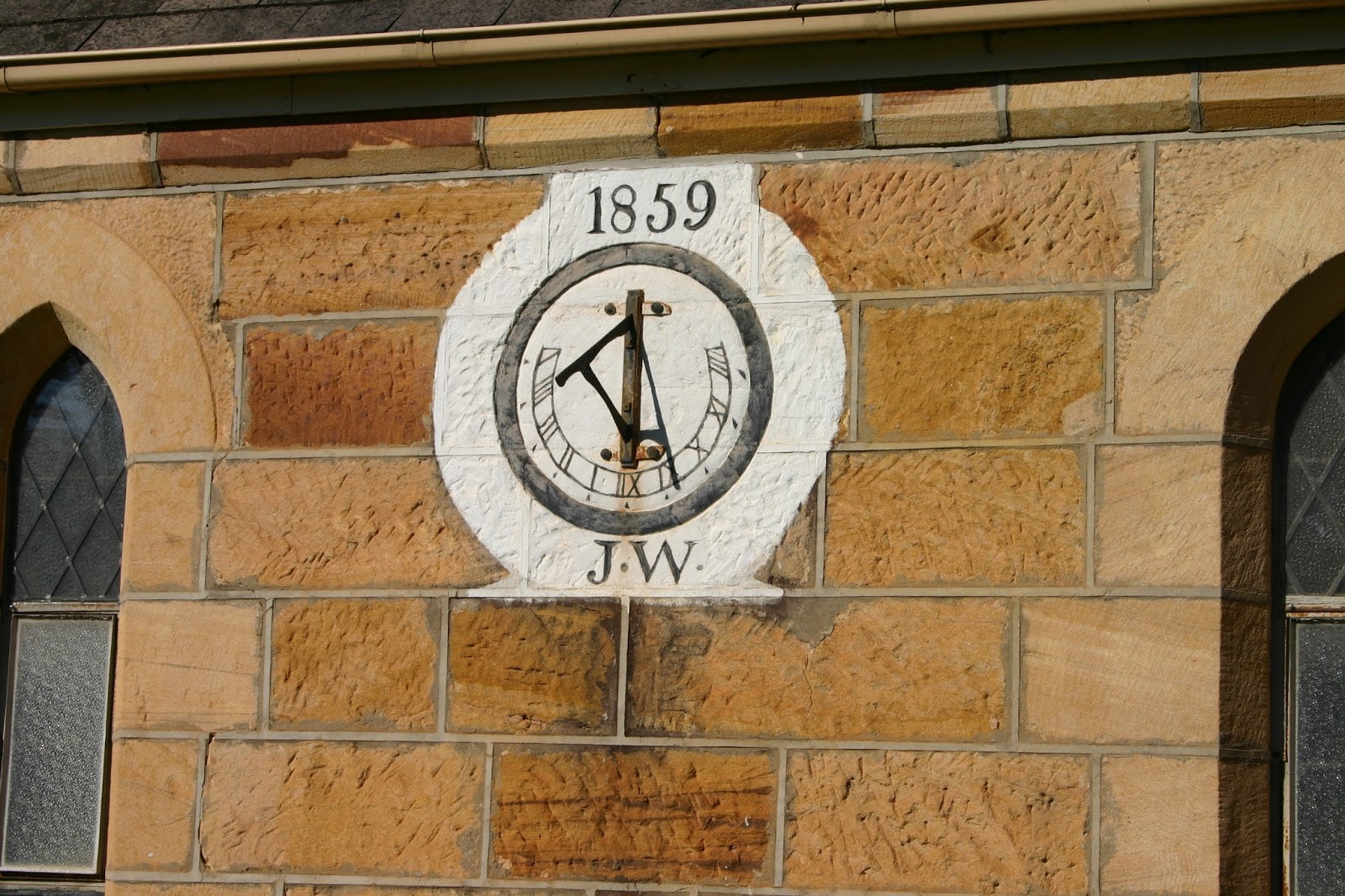
On the northernmost wall of Wilberforce’s St. John’s Anglican Church is a vertical sundial with the initials J.W. and the date 1859. Who was J.W. and what was the significance of the year?


The vertical sundial carved by John Wenban. Photo: M. Nichols


A sundial tells the time of day from the position of the sun, and the one at Wilberforce was carved by John Wenban, the local schoolmaster, to commemorate the consecration of St. John’s Church by the Bishop of Sydney, Mr Barker. 

Wheelwright John Wenban was from Hawkhurst, Kent, and accompanied by wife Mary and six children migrated to Australia in 1838. The couple had seven children but eight months prior to departure, their infant son Walter died. The family travelled on-board the immigrant ship the “Maitland” which recorded over thirty deaths throughout the voyage, mainly from typhus and scarlet fever. Heavily pregnant throughout the journey, Mary delivered her eighth child, Emily, five weeks after landing. Two more daughters were born in Wilberforce.

On arrival John was employed by Mr McDonald at Pitt Town and then later moved his family to Wilberforce.  In 1842, he was appointed as the Schoolmaster of the Parochial School at Wilberforce, replacing William Gow, the first schoolmaster and Parish Clerk. Classes were conducted at the Wilberforce Schoolhouse, built in 1819 at the request of Governor Lachlan Macquarie, and operated as a school during the week and a church on Sundays. As well as occupying the position of schoolmaster, John was appointed Parish Clerk. He also was a musician, providing music to accompany hymns for church services.  The organ was not purchased until the 1870s. 

In 1846 a committee was established to plan a new church in Wilberforce. The public were asked to make donations towards the cost of the building. John Wenban donated £3/3/- to the building fund. Money was raised and plans were drawn by architect Edmund Blacket, however it was 1856 before the foundation stone was laid. The exact date the church was completed is not known but it was consecrated in 1859. 

One evening in late November 1859, as the Wenban family was returning home in a spring-cart, an accident transpired. While turning a corner near the Wenban home, one of the wheels hit a pot-hole and John was thrown out. The horse bolted and the cart overturned with two of the children also severely injured. Twenty minutes after the accident, John succumbed to his severely fractured skull. The Sydney Morning Herald  5 Dec 1859 reported the accident,
FATAL ACCIDENT AND MAGISTERIAL INQUIRY
On Sunday evening last, just after sundown, Mr. John Wenban and family, of Wilberforce, were returning home in a spring-cart. In turning a corner, near his own house, one of the wheels of the cart went into a hole; the vehicle gave a sudden jerk, and Mr. Wenban was thrown out with great violence on the ground. The horse immediately became unmanageable, when the eldest daughter of Mr. Wenban jumped out and caught him by the head, but was unable to hold him. The animal then bolted off, and capsized the vehicle with three of the children underneath. Soon afterwards the horse got away from his harness, but not until two of the children were severely hurt. Mr. Wenban's skull was so severely fractured that he expired in about twenty minutes after the fall. A magisterial inquiry into the cause of death took place before Dr. Day, J P. (in the absence of the coroner) on the following day, when the foregoing facts were elicited - Mr. Wenban had filled the office of Church of England teacher at Wilberforce for several years, and was much respected by the inhabitants, very many of whom sorrowfully followed his remains to their final resting place on Wednesday.

An enquiry was held the following day with Dr Day acting as coroner. Aged only 56, John Wenban was buried in the local cemetery, a sad loss for his large family and the community.

John Wenban’s headstone at Wilberforce Cemetery. Photo: M. Nichols


Mary died on 30 August 1883 in her 77th year at her daughter’s home in Richmond. She was supposedly buried at Wilberforce however there is some dispute about this.


Today the sundial can still be seen on the outside wall of St. John's Church, reminding us of John Wenban’s contribution. 

Tuesday, 9 May 2017

Alfred Stearn, a man of quiet ways

When able seaman Alfred Charles Stearn arrived in Sydney as part of the crew on the sailing ship “David Brown” in 1877, he liked what he saw and chose to remain. 

Alfred was born in London in 1857 and with his limited education elected to go to sea. After arriving in Sydney he found work in an oyster saloon and regularly visited Windsor in his spare time. He was fond of Windsor and eventually moved to the town, where he established the Windsor Oyster Saloon which also sold prawns several days a week. In 1881, he married Mary Jane Mills in Sydney. Mary was born at Rouse Hill, the daughter of James Mills although she was adopted by James and Cecilia Hough as a baby, when her mother died. At the time of his marriage, Alfred’s occupation was recorded as an oyster and fish salesman. The couple had five children, Alfred James, Elysse Marie and William Oswald with Clara and Erich dying as infants. 

Alfred Stearn’s shop, 74 George Street Windsor.
Detail from postcard, personal collection


Eventually he expanded his business to include a general store situated in George Street where he was able to offer a wide selection of goods and services. During the 1880s he held a hawker's license, allowing him to travel around selling goods. Later, Alfred purchased land in Thompson Square opposite the Macquarie Arms Hotel, and constructed a shop with a residence above. It was two-storey with a cast iron verandah, and the parapet was decorated with a lion. Officially opened in August 1907, the building still stands today at number 74.  In the new store, Alfred continued to conduct his grocery business, as well as selling fancy goods and produce. The business also sold tobacco, fireworks, musical instruments, jewellery, optical glasses and insurance.

Stearn was described as, “Good-hearted and generous natured, he was one of the fine old type of Englishmen, but he loved the country of his adoption.” On every patriotic occasion he flew a selection of flags and was an admirer of the Monarchy and Empire plus a respected member of the local Masonic Lodge.

With a love of music, he often sang in concerts and musicals in Windsor and was a committee member of the Windsor School of Arts.

His death on 14 June 1925 was quick. He “came out to the front of his shop at about 10.30 o'clock where he collapsed and fell on the footpath. He died almost immediately.” His lengthy obituary appeared in the Windsor & Richmond Gazette, partially duplicated below. At the time he was aged 68 years old. Alfred was buried in St. Matthews Anglican cemetery, Windsor. In his memory, flags were flown at half-mast in Thompson Square, as well as at the Fire Station and McQuade Park.  Mary Stearn and her children were staunch Catholics. She died in 1940 aged 76 years and is buried in the Windsor Catholic Cemetery. Her husband Alfred was known as “a man of quiet ways and dealings — inoffensive and unassuming” an honest and respected resident of Windsor, the likes of whom not often seen today.

Obituary from Windsor & Richmond Gazette 10 June 1925, p. 3
Today, Stearn’s shop, 74 George Street Windsor houses Windsor Seafoods.

Thursday, 8 December 2016

Pictorial History Hawkesbury - revised, reprinted & for sale

Pictorial History Hawkesbury by Michelle Nichols has recently been revised and reprinted and is once again, available for sale.

To purchase an autographed copy $25.00 + $10 P&H go to Order Form For orders of 2-5 copies 5% discount and P&H $15. Copies are also available to pick up in Windsor or Richmond, please contact the author 0408 694 919. Copies are also available from Tizzana Winery at Ebenezer and most bookstores.


The Hawkesbury district was originally occupied by the Darug and Darkinjung tribes and following European settlement in the 1790s the Hawkesbury district developed into one of the major settlements in the colony. Many Australians can trace their origins, both convict and free, to this district and many descendants still live in this historic region.

Chapters of the book cover:

  • Setting the scene
  • Original Occupants
  • Exploration & early European Settlement 
  • Macquarie Five Towns


The publication also includes a history of Hawkesbury localities which extend from Bilpin, Colo, Ebenezer, Kurrajong, Mount Tomah, Pitt Town, Richmond, Wilberforce, Windsor, St Albans and Wisemans Ferry illustrated with almost 200 black and white historic photographs giving a fascinating overview of the history of the area from Aboriginal to modern times.

Michelle Nichols has worked as a Local History Librarian for over 30 years. She published 'Disastrous Decade: Flood & Fire in Windsor' in 2001 and co-authored 'Hawkesbury 1794-1994' with Jan Barkley Jack. She has been the editor of several journals as well as the 'Hawkesbury Pioneer Register 1 & 2.' Michelle received an OAM for her work on local history. A keen photographer, she transcribes Hawkesbury cemeteries  with her husband, Jonathan Auld. 

This is part of a series of pictorial histories and is also available for sale through the publisher Kingsclear Books 

ISBN 0-908272-78-2

Monday, 28 November 2016

Death of an astronomer: Hawkesbury's John Tebbutt 1834-1916

On this day, 100 years ago (29 November 1916) astronomer John Tebbutt, passed away. In Australia he was known for his devotion to astronomy yet internationally he was greatly admired. Tebbutt’s observations assisted in advancing astronomy throughout the world yet he rarely left the Hawkesbury. 
John Tebbutt at the Pensinsular Observatory, Windsor 1915 [Source: Early Days of Windsor by J. Steele, 1916]

The son of John and Virginia Tebbutt, John was born in Windsor on 25 May 1834. His grandfather, also called John, arrived in Sydney as a free settler with his family on the ‘Nile’ in 1801. Soon after their arrival in the Hawkesbury, the family purchased properties and established businesses. In the 1840s Tebbutt’s father, purchased land on the Peninsula near South Creek and built a two-storey house.

Educated in Windsor, it was parish clerk Edward Quaife, who instilled in the young John Tebbutt a love of astronomy. Tebbutt was later taught by the Presbyterian minister, Reverend Matthew Adam, then Reverend Henry Stiles the Anglican minister. He was tutored in the classics including Latin and Greek and in later years, taught himself French and German. To work in the field of astronomy an understanding of not only science, but also higher mathematics was required. Tebbutt was fascinated with all types of machines and studied various mechanisms as well as steam engines. 

With his aptitude for astronomy, Tebbutt purchased his first instrument, a marine sextant in 1853. With advice from John Stiles a retired Royal Navy midshipman and brother of his tutor, Tebbutt commenced his examination of the skies in earnest. The results of one of his earliest observations appeared in  the ‘Sydney Morning Herald’ in 1854. 

Tebbutt's letter to the Editor, Sydney Morning Herald 13 May 1854, p. 5. 

Tebbutt also prepared detailed observations of the Donati comet which was discovered in 1858.

In 1857, Tebbutt married Jane Pendergast at St. Matthew's Anglican Church, Windsor. The couple who made their home in Windsor, had six daughters and one son. Tebbutt was a deeply religious man, and a member of the St. Matthew’s Anglican congregation. Tebbutt had expressed that, "The truth shall make humanity free whether it be religious or scientific and we scientists have to fight for that freedom."

In the early days Tebbutt’s instruments were simple but in 1861 he purchased a refracting telescope and the following year, a set of meteorological instruments. In later years he was able to purchase more substantial telescopes and equipment. He meticulously recorded meteorological statistics and Hawkesbury River flood levels throughout his life. During 1861 he discovered the Great Comet which gave him international recognition then twenty years later discovered the Great Comet of 1881. When William Scott (1825–1917) the first government astronomer resigned in 1862, Tebbutt was offered the position however he declined in order to concentrate on his own efforts. Despite not accepting the position he was still considered as one of Australia’s foremost astronomers by his international peers, which caused some repercussions throughout his career. 

Tebbutt built the first of several observatories on the family property in 1863. This building constructed by Tebbutt himself, was wooden with a slate roof, and included a transit room. The following year he purchased a transit instrument and a chronometer. In 1874 he built a circular building, a few metres from his original observatory, to house his 4½ inch equatorial telescope. To assist with his observations, he purchased a Dublin made, Grubb 8 inch equatorial refractor. In 1879 an extensive brick observatory was constructed on the property. It included a meridian room, a fire proof office which contained a library. An Equatorial room was built in 1894 replacing the older wooden building. 

Tebbutt’s consistent observations and astronomical computations were highly regarded by his international colleagues and assisted in progressing astronomy worldwide. In 1867 he received the silver medal of the Paris Universal Exhibition for his paper on the Progress of Astronomy in NSW. Tebbutt was elected a member of the Royal Astronomical Society in 1873 for his contribution to astronomy and when the British Astronomical Association formed the NSW Branch in 1895, Tebbutt was elected as the founding president. For his service to astronomy in Australia he was awarded the prestigious Hannah Jackson nee Gwilt gift and bronze medal from the Royal Astronomical Society, London in 1905 “for his important observations of comets and double stars, and his long-continued service to astronomy in Australia, extending over half a century.” Aged seventy he retired from his routine recordings but maintained his interest in astronomy. 

This can be read online


During his career he published almost 400 articles. He also published the “History and description of Mr. Tebbutt's observatory, Windsor” and "Astronomical Memoirs". The following year, despite his retirement, Tebbutt observed and recorded Halley’s Comet.

View of Tebbutt's vault at St. Matthew's Anglican Cemetery, Windsor and inset below

John Tebbutt died on 29 November 1916, aged eighty-two, after being unwell for a few weeks. His cause of death was recorded as cerebral paralysis. His funeral was held in Windsor’s St. Matthew's Anglican Church and was reported as one of the largest ever held in the Hawkesbury. The prominent astronomer was buried in a vault which he personally designed and had constructed several years before his death. The four corners mark the four points of the compasses and are topped with a globe with longitudinal and latitudinal lines. It rained heavily on the day of the funeral. His coffin travelled by hearse to the church followed by mourning coaches carrying the family, long lines of pedestrians, horsemen and motor cars. 

During the service, Rev Fielding paid tribute to Tebbutt, "one of the most eminent Australians” and noted that “perhaps his character and his remarkable work were not appreciated in their true value in the town…where he spent the whole of his long life.” Many important citizens travelled to Windsor to join with family and the local community to bid farewell to the gifted astronomer. 

After his death, Tebbutt continued to receive accolades. The International Astronomical Union renamed a lunar crater on the moon in 1973 to commemorate his achievements. Tebbutt also appeared on the first Australian $100 banknote in 1984, this was replaced in 1996. 

Hawkesbury Council acquired his Grubb telescope many years ago, and it is on loan to Tebbutt’s observatory. Descendants still live on the property where the original house alongside two of Tebbutt’s remaining observatories. His globe is on display in Hawkesbury Regional Museum. A distinguished astronomer, John Tebbutt remains a name respected amongst eminent stargazers. 

In 1984, Hawkesbury Council reprinted Tebbutt's 1908 "Astronomical Memoirs" - this was the same year the $100 banknote was introduced. It is still available for sale at Hawkesbury Library.


Sources
LATE MR. JOHN TEBBUTT. (1916, December 2). The Sydney Morning Herald (NSW : 1842 - 1954), p. 14. 
ASTRONOMER DEAD. (1916, November 30). The Sydney Morning Herald (NSW : 1842 - 1954), p. 8. 
DEATH OF MR. JOHN TEBBUTT (1916, December 8). Windsor & Richmond Gazette (NSW : 1888 - 1954), p. 2. 
VALE! JOHN TEBBUTT (1916, December 15). Windsor & Richmond Gazette (NSW : 1888 - 1954), p. 2.
Harley Wood, 'Tebbutt, John (1834–1916)', Australian Dictionary of Biography, National Centre of Biography, Australian National University, , published first in hardcopy 1976, accessed online 28 November 2016
Biographical Entry, John Tebbutt (1834 - 1916) from Encyclopedia of Australian Science Archival and Published Resources 

Friday, 14 October 2016

ELIZA KINGSWOOD: A CENTENARIAN

An elderly lady passed away in Richmond during Easter in 1893. This was not just any woman, but one that had caught the media attention in the 1890s. Mrs Eliza Kingswood was apparently 103 years of age when she passed away in Richmond. Who was this remarkable woman and what was her story?

Born Eliza McNamara around 1790, she was apparently born in Ireland.. She became the wife of Sgt. John Kingswood. A soldier who had participated in the Continental War in 1815, however not in the Battle of Waterloo. The couple eventually arrived in Australia in the 1820s. 

“A much respected soldier” - John and his wife settled in the Kurrajong district, where they grew maize. They then moved to Richmond and lived in a property in March Street. They had one daughter, Mary who was born in the late 1820s. In 1845, Mary married Richard Gow 1822-1889. Richard was the eldest son of convict William Gow 1797-1872 and Maria Dunston 1807-1865. They had at least one son, Francis John, who was born in the Hawkesbury in 1847. Regrettably Mary died 24 October 1865, aged 36 years old. She was buried at the Catholic Cemetery in Windsor. Her headstone (pictured below) indicates that she may have been ill for a long period prior to her death. It states: 

Sickness sore long time I bore
Physicians was in vain
Till God did please to give me ease
And free me from my pain.

Eliza Kingswood's headstone, Windsor Catholic Cemetery

Mary’s husband, Richard Gow, died on 7 October 1889 in Cudgegong.  Despite the early death of their daughter Mary in 1865, both John and Eliza lived on in March-street, Richmond. John Kingswood reached the ripe old age of 95 years old, and passed away in January 1887.  The Freemans Journal reported that "Another Good Old Colonist Gone." It stated that John Kingswood died at the residence of  his grandson, Mr F. J. Gow,
New South Wales has lost one of its very oldest colonists, and one who has won the highest respect of his neighbours. Mr. Kingswood, who had reached the grand old age of 95 years, came to the colony with his wife (who survives him, although she is also 95 years old) in 1826. The good old gentleman preserved all his faculties up to the last, and until attacked by the short illness which carried him off, was able to attend to his ordinary business affairs. Mrs. Kingswood is a fine example of an old lady who has led a simple life, and now, at the age of 95, is as clear in intellect as she ever was.

Eliza Kingswood celebrated her 100th birthday and at the time it was recorded that “her sight and intellect were unimpaired” and she did not require spectacles for reading and was still reasonably mobile. Yet when aged 98 years, Eliza was interviewed for a popular magazine, and although possessing all her mental faculties was not so physical active. Obviously the media liked to stretch the truth, even in those days. The article from the Australian Town & Country Journal 6 August 1892 states:
…Elizabeth Kingswood, 98 years of age, whom I interviewed. Her lower limbs are partially paralysed, otherwise she is as healthy as possible. She is constantly reading, and can read the smallest print without the aid of glasses. She informed me that previous to five years ago she required glasses, but not feeling the need of them, owing to either the loss or breakage of her pair, she has done without them ever since. She stated she went to Monarco[sic] with her parents about 1801 ; she was then between 6 and 7 years of age. Her father was a soldier, and served in the Battle of the Nile. Her husband was a sergeant in the 57th Regiment, which was known as the "Die Hards." They used to live in the old barracks, now Wynyard Square, Sydney.  

Eliza lived for another three years, and died aged 103 years in Bosworth Street, Richmond. Her death, on the 2nd April 1893, was recorded in numerous newspapers including local newspapers as well as Australian Town and Country Journal, Singleton Argus, Clarence and Richmond Examiner, the Sydney Morning Herald and even Broken Hill’s Barrier Miner.  The cause of death was recorded on her death certificate as diarrhoea and exhaustion, both treatable but disastrous for an elderly person. She was ill for a week and seen to by Dr. W. M. Helsham of Richmond, furthermore on her last day on earth. 

Eliza was buried on the 4 April 1893 at the Catholic Cemetery in Windsor. The service was taken by Rev. E Hanrahan and William Tomkinson was the Undertaker. The details of her death appeared in numerous newspapers and an obituary was published in the Windsor & Richmond Gazette, 8 April 1893, and read:


An old lady, who has been a resident of the district for many years, passed away on Easter Sunday night at 10 o'clock, at Richmond, at the advanced age of 103 years. Deceased was grandmother to Mr F. J. Gow partner in the well-known firm of John Bridge and Co., and was the relict of the late Mr, John Kingswood, an old soldier, who died about 10  years ago at the advanced age of 95 years. Deceased and her husband first came to reside at Kurrajong, and after living some years there, came to Richmond and built a house for themselves in Francis-street, where they resided several years. Here Mr. Kingswood died. When deceased's grandson, Mr. Gow, went to reside in Sydney, he tried to induce deceased to accompany him, but as she desired to remain in the town of her adoption, she was placed under the care of Mrs. Cashel and family, Richmond, where she remained until her death. Deceased had one daughter, mothers Mr. F. J. Gow, who died many years ago. Notwithstanding her great age, Mrs. Kingswood experienced excellent health up to the time of her death; enjoying her meals heartily. She was however unable to walk about or use her hands for the past few years. Deceased had marvelous eyesight, and right up to the last was able to read small print without the aid of spectacles, a fact which somewhat surprised her medical attendant, Dr. Helsham. The funeral took place on Tuesday afternoon at Windsor, at 4 o'clock, her remains were interred in the R. C. Cemetery. There were not many present owing to most people being away from home at Easter-time. Mr. Tompkinson carried out the duties of undertaker, and gave satisfaction.  
The headstone in the Catholic Cemetery at Windsor also records the death of Marjorie Mary Gow a four month old baby. Marjorie was the daughter of Francis and Clara and died the 24 August 1898 aged 16 weeks.  Her death was registered in Woollahra. By this time, Francis and his family were living in the Eastern Suburbs and he was working as a produce merchants. 

Francis Gow passed away in 1928 aged 81 years. He lived at ‘Maybourne Lodge’ Cook Road, Centennial Park. He worked for many years at John Bridge & Co. in Sussex Street but in 1929, he was a director of the Hotel Sydney Ltd. and the Ranelagh Hotel in Robertson. He was “survived by a widow, two daughters, and five sons. The funeral took place at Waverley Cemetery.” 


Sources:
Reminiscences of Richmond : from the forties down / by "Cooramill" [Samuel Boughton] & Cathy McHardy (2010) p. 154
Inscription from the Cemetery Register. Windsor Catholic Cemetery from Hawkesbury on the Net http://www.hawkesbury.net.au/cemetery/windsor_catholic/wwcc876.html 
Family Notices. (1887, January 26). The Sydney Morning Herald (NSW : 1842 - 1954), p. 1. Retrieved November 17, 2012, from http://nla.gov.au/nla.news-article28353709
DEATH OF A CENTENARIAN . (1893, April 6). The Advertiser (Adelaide, SA : 1889 - 1931), p. 5. Retrieved November 17, 2012, from http://nla.gov.au/nla.news-article25649191
Richmond. (1892, August 6). Australian Town and Country Journal (NSW : 1870 - 1907), p. 28. Retrieved November 17, 2012, from http://nla.gov.au/nla.news-article71202352
Australian Town and Country Journal (1893, April 15). p. 17 retrieved from http://nla.gov.au/nla.news-article71197691 
Singleton Argus (1893, April 8), p. 1 http://nla.gov.au/nla.news-article82454217
Clarence and Richmond Examiner (1893, April 8) p. 5 http://nla.gov.au/nla.news-article61250133  
Sydney Morning Herald  (1893, April 17) p. 8 http://nla.gov.au/nla.news-article13928940
Death of a Centenarian. (1893, April 8). Windsor and Richmond Gazette (NSW : 1888 - 1954), p. 10. Retrieved November 17, 2012, from http://nla.gov.au/nla.news-article72546529
Town Gossip. (1898, September 10). Windsor and Richmond Gazette (NSW : 1888 - 1954), p. 3. Retrieved November 17, 2012, from http://nla.gov.au/nla.news-article66438869
OBITUARY. (1928, April 6). The Sydney Morning Herald (NSW : 1842 - 1954), p. 4. Retrieved from http://nla.gov.au/nla.news-article16455247
MR. O'RYAN'S LECTURE ON EMMET. (1887, January 29). Freeman's Journal (Sydney, NSW : 1850 - 1932), p. 15. Retrieved October 14, 2016, from http://nla.gov.au/nla.news-article115446025